Whispers of the Ancient Patch: A Ballad from 2042’s Update 1.1
I still remember the exact moment the servers came back online—the air humming with latent potential, the digital soil of the Battlefield uneasy beneath my boots. It was 2026, but the heartbeat of 2042 had quickened once more with Update 1.1. That patch arrived like an old war letter, carrying not just tweaks and tunes, but a new philosophy writhing beneath its code. The menus greeted me with a subtle gift: a glowing widget whispering the number of friends online, their names like stars clustered in a social tab constellation. Even the voice chat revealed its hidden face, showing which device drank my battle cries. No more controller silence at launch; we stuck together now—squads like migratory birds, never lost in the lobby limbo.
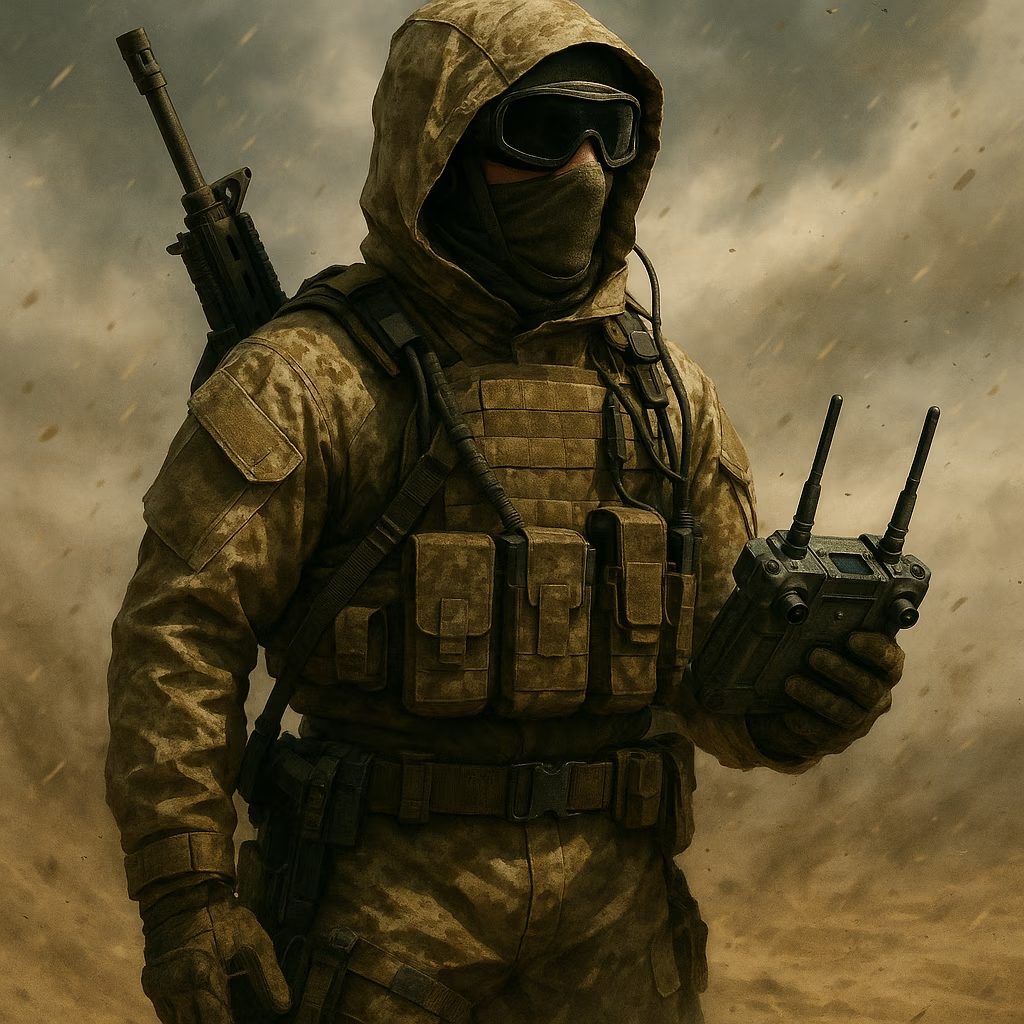
But the true rebirth trembled in the Portal. I stepped into Air Superiority and Ground Superiority presets as if into freshly painted myths. The Rules Editor had grown new tendrils—blocks to compare vehicle names, to sense a tank’s velocity, to count every soul inside a metal beast. Suddenly I could script the chaos: disable passenger seats, unleash a swarm of solitary fighters; tweak health multipliers until machines became glass cannons or iron fortresses. Infinite magazines and accelerated projectiles turned throwables into hummingbirds of death. The classic maps felt re-forged with extra-small layouts for Battle of the Bulge, El Alamein, Kaleidoscope, and Manifest—intimate arenas where vehicle TDM became a frantic, bloody minuet. And the audio! New voices rose like ghosts from 1942: the British Engineer’s crisp defiance, the American Anti-Tank’s gritty resolve, and dear Günter, the German Engineer, speaking with a timbre that could bend steel. Bad Company 2 received the Hind and BMD-3, twisting old allegiances into fresh nostalgia.
Hazard Zone, once left to wither, had been given a second chance—literally. The Data Drive Scanner, now costing precious credits, only revealed carriers; data drives glowed globally in the world like beacons of greed. IBA Armor Plates became my birthright, free and default, while the Second Chance mechanic resurrected a wiped squad after fifteen seconds, dropping us from 500 meters, parachutes denied until the last 100—a fall into redemption. Insider Information grew richer, revealing impacts sixty seconds ahead, and Biometric Scanning marked enemies longer, painting their silhouettes in my mind’s eye. The start timer shrank to a single heartbeat, and the pointless Map Overview vanished, hurling us into the fray without ceremony.
The weapons sang a revised ballad. DMRs finally found their horizon-song: bullet velocities climbed—BSV-M at 790, SVK at 960, VCAR at 700, DM7 at 800—making long-range whispers into screams. Headshot multipliers stretched like shadows at dusk, rewarding the disciplined hand. The M44 Revolver now carried its righteous punch up to 75 meters, a pocket cannon against arrogance. And the animations… oh, they mended the dissonance. Melee attacks no longer clipped through walls when vaulting; I could aim down sights while prone and still inch forward like a serpent in grass. Hip rotations softened, leaning became visible to my enemies in third-person, and idle stances breathed with new life. Gone was the broken dance of ADS and vault; the revive animations shed their spooky misalignments, no longer fearing the dead. The kill card itself evolved—nearby allies appeared alongside the killer’s details, and an elegant animation slid it onto my screen like a requiem.
Vehicles, those iron titans, received a poetic recalibration. The F-35E Panther and SU-57’s 25mm cannon grew teeth: damage up from 20 to 30, dispersion tamed, a beast now reliable even at 250 meters. Air-to-ground missiles quickened their rate of fire, yet demanded patience in lock times, a dance of aggression and calculation. The Nightbird’s cannons slowed to 200 RPM, their replenishment stretching, while the MAV’s autocannon transformed into a close-range brawler with slower but heavier shells and a concussive blast. The Condor’s 50mm cannon pod turned singular and deliberate, a ponderous war drum. Even lock-ons grew fluid, with no delay to acquire new targets, and anti-tank missiles clung to empty vehicles to prevent heartbreak. And in a moment of absurd beauty, driving over a street lamp no longer shoved the camera inside the hull—“vehicle love lamp,” the notes teased, as if acknowledging the marriage of chaos and charm.
The specialists, each a fractured poem, found their verses corrected. Angel’s crate no longer scolded me with error messages, and his trait reworded to reflect an ammo-only creed. Boris’s sentry gun learned to shatter glass, to obey placement on Exposure’s tricky contours. Dozer’s shield now blocked G-84 TGM missiles as if defying the sun. Falck’s syrette pistol shed its red-lined madness when aiming, and friendly fire voiceovers ceased their false accusations. Lis felt the EMP field drag her out of the TV screen with a one-second delay, her missile no longer bouncing off bushes or chasing Sundance’s anti-armor grenade in a self-destructive waltz. Sundance’s UI un-stuck itself, and Rao’s silent fixes hummed underneath. Paik’s unseen tweaks awaited discovery. Every tweak to UI/HUD made the commorose succinct, friendly fire no longer painted allies as enemies, and hit indicators respected the dead’s rest.
Breakthrough became a crucible of clarity. Distinct attacker/defender icons burned on objectives, directional retreat indicators guided the defeated like shameful signposts, and objective descriptors—“Hold,” “Defend,” “Attack,” “Retake”—spoke the raw language of intent. The match’s audio thickened with tension, a cinematic crescendo before the end-of-round screen smoothed over the transition like oil on troubled water.
Even the small things, the forgotten corners, were polished: weapon charms now always visible, bonus missions displaying correct expiration, completed challenges retroactively granting their rewards. New XP events bloomed—Pilot Kill Bonus triggering when I sniped an aviator mid-flight, Disarming Mine rewarding my careful fingertip, Repair Assist lending me a share of my driver’s kill. Spot assists reduced to 10 XP, making each point feel earned. The kill log finally told the whole story with “Show Kills Made” set to ALL. Those spiderwebs of bug fixes—Terrain clips, broken slide jumps, misdirected tracers, stealth helicopter bomb jitters—all mended as if a great loom had passed through the code.
I return to this patch in memory, knowing 2026 holds newer battles, yet the soul of Update 1.1 still beats. It was a love letter to the broken and the bold, a testament that even when a mode is meant to be left behind, the developers will reach back to plant a seed of redemption. And so we fought, in the skies, on the scorched earth, with rules of our own making, forever buoyed by the knowledge that the battlefield never really forgets—it only waits for the next stanza.