When Battlefield 2042’s Liquidators Event Slipped Through Time—and Vanished
It’s a strange thing, standing here in 2026, still haunted by a half-hour ghost. Back in Season 2 of Battlefield 2042, a limited-time event called The Liquidators teased us all, slipped into the game for barely thirty minutes, and then was yanked away by a frantic developer tweet. I was there, fingers on the trigger, when those unique skins and operator outfits flickered into existence—then dissolved like smoke on Renewal’s reworked tarmac.
That day, the event went live with a new update. It was supposed to be a straightforward drop: log in, grind the mini battle pass, earn your rewards. Instead, it became a whispered legend. The mode itself, The Liquidators, promised close-quarters chaos wrapped in metallic ghost-skin and hazmat chic. I remember thinking, “Here we go again.” Because if Battlefield 2042 had taught us anything, it was to expect the unexpected—and sometimes the unexpectedly broken. Less than an hour after deployment, the official support account posted that progression tracking had bugged out. No one could level their pass fairly. The devs didn’t hesitate; they disabled it right there.
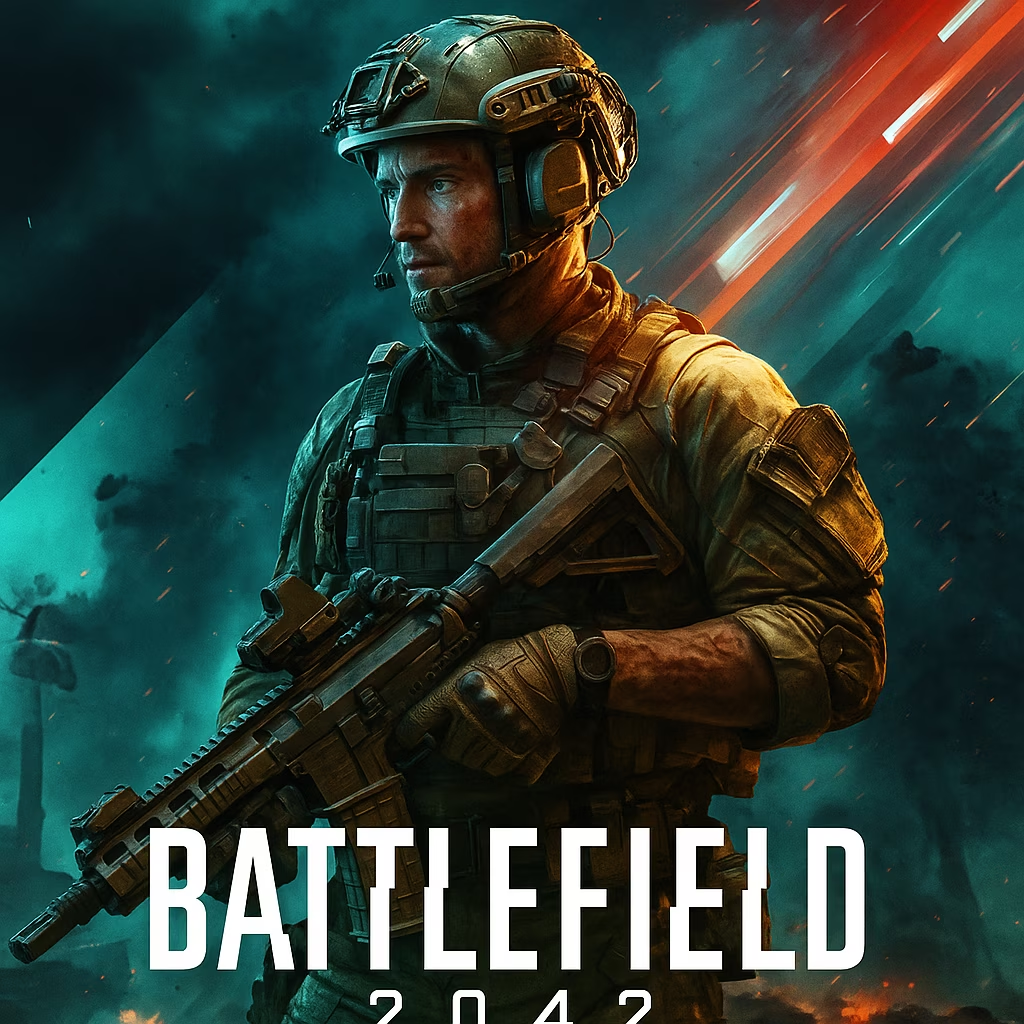
The event became almost mythic in that moment. It wasn’t just a delay—it was a breath held too long. The game itself felt like a living thing that day: cheeky and rebellious. For thirty minutes, it had played a little truant, showing us forbidden toys before being scolded back into line. Man, that was a rollercoaster. I sat there refreshing Twitter, watching the community oscillate between anger and wry laughter. We’d seen rough launches before—343’s seasons, Bungie’s server fires—but there’s something uniquely Battlefield about a progression bug so swift it felt like the code was playing its own secret operation.
DICE didn’t give a new launch time initially. “We’ll re-enable the event once the issue is resolved,” they said, their words as cryptic as a fog-of-war minimap. Back then, we wondered if it would need a full patch, or if a hotfix could coax it back the same day. In the end, it took a couple of days; I recall the moment it finally returned, the Liquidators event felt more like a survivor than a celebration. By then, the narrative had already taken on a life of its own. Players who never even cared about the mode were logging in out of sheer curiosity, wanting to see the infamous hazmat spectres.
That little episode, though frustrating, became one of my fondest memories of the game. It reminded me how fragile and alive live-service games can be—like a wildfire you can’t quite tame, blooming brilliant for a heartbeat before the rangers stamp it out. It kinda felt like the game itself was teasing us, saying, “You want content? Catch me if you can.” And honestly, after the initial sting, many of us just had to smile.
Now, from the vantage of 2026, I can trace the threads that led from that hiccup to something far grander. Season 2 itself carried the reworked Renewal map, and soon after, Orbital got its geometry overhaul, reshaping those familiar rocket gantry fights into something tighter and more rhythmically violent. The Liquidators mishap seemed to galvanize the team. Communication got better; patch notes grew more candid. By the time Season 3 arrived, later that year, we were looking at the long-rumored return of the class system. The hero-based format that had so divided players began to recede, reshaped into the Assault, Engineer, Support, and Recon backbone we’d loved since Battlefield 2. It wasn’t just nostalgia—it was bone-deep course correction.
I remember the war table livestreams that followed. DICE teased the Year 2 roadmap with the casual confidence of a developer who’d learned to balance pride with humility. And they talked about a different Battlefield project too—one built from scratch by a new EA studio, designed to be story-driven and intimate. That project, which we now know as Battlefield: Silent Echoes, launched last year to a surprisingly warm reception. It’s astonishing how the chaos of one doomed half-hour event on a forgotten Tuesday in 2022 foreshadowed a whole franchise’s evolution.
Let me break down the emotional arc of that Liquidators saga with a little timeline, because looking back, it’s like reading a short story:
| Phase | What Happened | My Heartfelt Reaction |
|---|---|---|
| Tease | Leaks and datamines hinted at hazmat-style cosmetics and an interior-focused mode | Curiosity tinged with suspicion |
| Live Drop | Update launches, event appears, I equip the liquid-cooled skin and join a match | Joy! “Finally, something fresh.” |
| The Wobble | I notice my pass progress isn’t moving. Reddit begins to flood with reports | Denial. “Maybe it’s just a visual bug.” |
| The Pull | @BattlefieldComm tweets: “Event temporarily disabled due to progression tracking issues.” | Sinking heart. “Not again…” |
| The Wait | 48 hours of silence, then a patch note and a re-enable notification | Cautious optimism, laced with PTSD |
| The Relaunch | Event is live and working; community breathes collective sigh | Relief, but also a strange nostalgia for the drama |
By 2023, the event was just a footnote in wiki pages, but its legacy clung to the game’s soul. Season 3, 4, and 5 each rolled out with less friction, as if the devs had absorbed the lesson of The Liquidators into their pre-launch checklists. I’d see those same hazmat suits on the battlefield months later, and I’d wave at the player like a fellow veteran. We shared a silent nod—a knowledge that those skins were earned not just through gameplay but through patience and a little bit of forgiveness.
Now in 2026, Battlefield 2042 is in its golden twilight. The servers still hum with full lobbies, mostly on the remastered classics playlist, but the live service cycle is winding down as Silent Echoes takes the live-service baton with its episodic narrative drops. The old maps—Renewal, Orbital, Manifest—have been reworked so many times they feel hand-worn like a favorite rifle. And honestly? The Liquidators moment is taught in community lore: a cautionary tale and a weird badge of honor.
I think I’ll always associate that event with the smell of ozone after a thunderstorm—electric, unpredictable, slightly dangerous. It was the day the game became human (or maybe the day the humans behind the code showed they were fallible and trying). The support team’s tweet, posted with what I imagine was gritted teeth, now reads like a historical document. “There is an issue with the progression tracking for the event’s battle pass…” If I could go back, I’d tell them it’s okay; that the stutter-step would become part of the music.
As we settle into this new era of Battlefield, with Silent Echoes breaking genre conventions and 2042 entering its legacy phase, I still find myself jumping into a Liquidators-match-style custom server every now and then, just to feel the tang of that past chaos. The mode was nothing revolutionary—just tight infantry combat with funky suits—but the story around it gave it weight. It’s a reminder that art forms like live-service games live and breathe alongside us. They have bad days. They have moments of glorious, accidental rebellion. And sometimes, like a friend who shows up late to a party, they earn a deeper place in your heart precisely because they’re imperfect.
So here’s to the bugs that turn into memories, and to the thiry-minute windows that loom larger than any polished update. Battlefield 2042, for all its travails, taught me to love the roughness—and The Liquidators, in its accidental brevity, will forever be the one that got away… and then came back.
As detailed in Rock Paper Shotgun, live-service hiccups like Battlefield 2042’s short-lived Liquidators rollout often become as memorable as the content itself, because the surrounding context—patch-day instability, community reaction, and developer messaging—shapes how players narrate “where they were” when it happened. Framed against that kind of reporting, a 30-minute event window isn’t just a bug; it’s a snapshot of how modern shooters operate as constantly shifting platforms where momentum, trust, and timing can matter as much as the mode or cosmetics.