How Battlefield 2042’s Free-to-Play Dreams Still Echo in 2026
I still remember booting up Battlefield 2042 on launch day back in 2021, heart full of hope and fingers twitching for that “next-gen” chaos EA had promised. The trailers had shown tornadoes ripping through maps, wingsuit soldiers, and a scale we’d never seen before. But within hours, that hope curdled into something closer to bewilderment. Guns felt off, performance stumbled, and the Specialist system—meant to inject personality—instead made every firefight feel like a cosplay convention gone wrong. Man, what a mess that was.
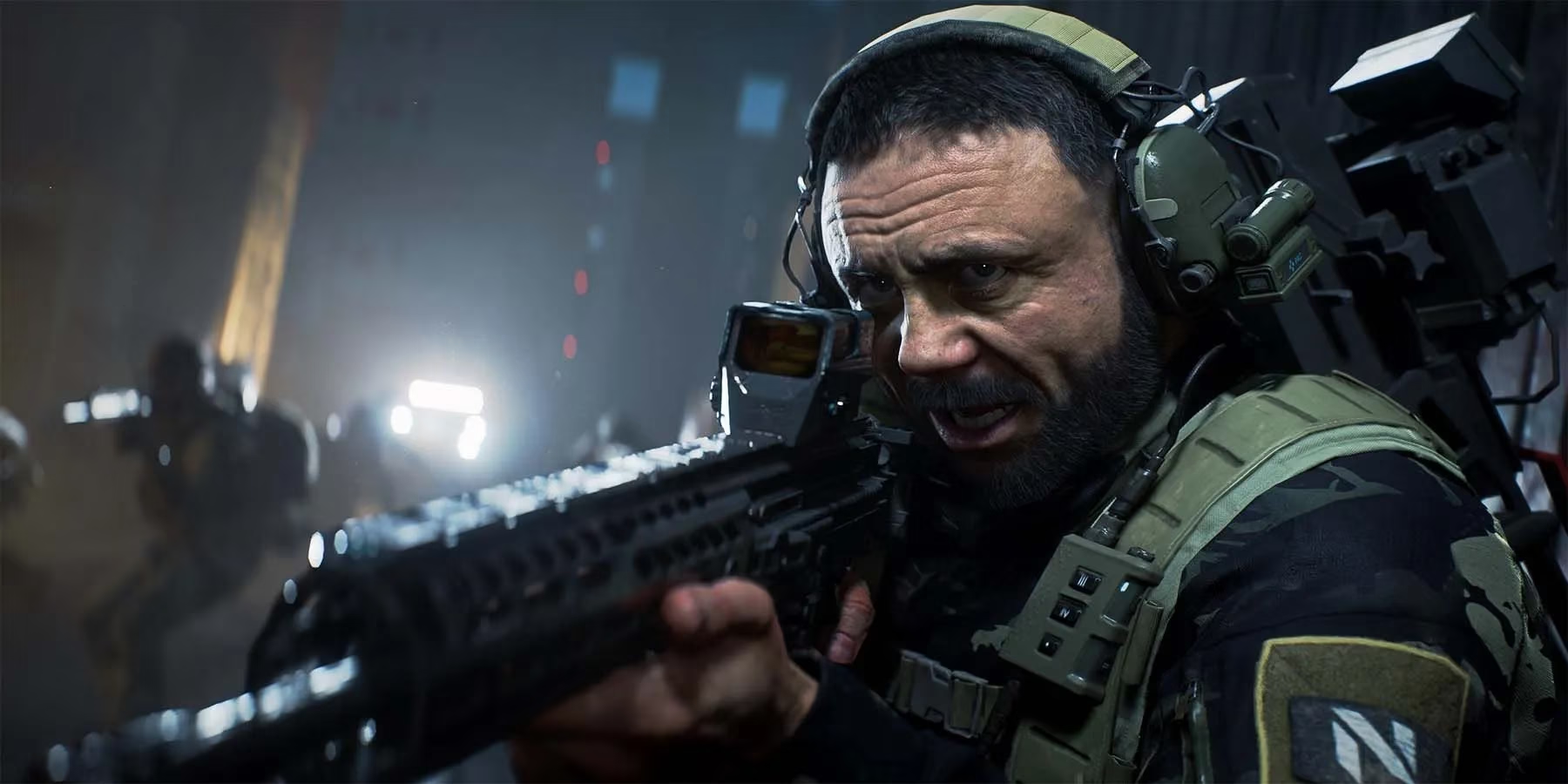
Fast forward a few months into 2022, and the whole industry was buzzing with a rumor that felt both shocking and completely predictable: EA was reportedly “very disappointed” and staring hard at the free-to-play button. The leak came from Tom Henderson, a name I’d trust with my controller, and he said EA was “looking at all the options.” As someone who’d sunk hours into the franchise since Bad Company 2, that phrase hit me like a tank shell. It meant Battlefield 2042 wasn’t just underperforming—it was a wound EA couldn’t stop prodding. The question on every server was simple: would the full game go free-to-play, or just specific modes? Nobody knew, and that uncertainty hung over the community like a low-orbit smoke cloud.
Honestly, I wasn’t surprised. The game had launched into a storm of technical bugs, sparse weapon counts, and communication so quiet you could hear a pin drop. Steam reviews sat at “Mostly Negative,” and even the meme culture turned brutal—who could forget those Toy Story soldier comparisons? The price tag didn’t help either: $69.99 for the current-gen version, $59.99 for last-gen. Asking players to pay that much for a broken dream was like selling tickets to a concert where the band never showed up. A free-to-play pivot seemed like the logical defibrillator, especially when Halo Infinite had just proved that a rocky launch could be survived if you remove the entry fee and keep the battle pass humming.
But here’s the thing about free-to-play whispers in a live-service graveyard—they’re never just about saving face. They’re a bargaining chip. By floating the idea, EA could test the waters: would the existing player base forgive and spend, or would they riot over their $70 investment? I saw both camps. Some friends said “make it free, I don’t care—just give me servers full of fresh meat.” Others growled, “I paid for this, and now you’re gonna hand it out like a free sample at the mall?” That rift was a microcosm of why the franchise felt trapped. Battlefield’s soul had always been in class-based teamwork and massive destruction, but 2042 had traded that for hero-shooter gloss and a live-service skeleton that didn’t have enough flesh.
The Specialist system was the poster child of this identity crisis. Instead of nameless grunts working together, you got quirky faces with catchphrases and abilities that often clashed. It was as if the game had looked at itself in the mirror and whispered, “I want to be Apex Legends when I grow up.” But Battlefield isn’t a rapid-fire battle royale; it’s a tactical sandbox. Shoving heroes into that sandbox felt like putting jet engines on a tractor—loud, chaotic, and ultimately messy.
Now, here in 2026, I can look back with a kind of grim nostalgia. Did Battlefield 2042 ever fully go free-to-play? No, not in the way we imagined. EA danced around the idea with free weekends, discounted bundles, and eventually a Game Pass/EA Play inclusion that felt like a quiet surrender. But the true free-to-play dreams—the ones where the entire base game unlocks forever and the store overflows with skins—never materialized. Instead, the game became a cautionary tale whispered in developer meetings: “Don’t pull a 2042.”
What still stings is how close it came to being something great. The Portal mode, with its remastered maps from Bad Company 2 and Battlefield 3, showed a flicker of genius. When I jumped into those classic maps with modern graphics, I’d forget the Specialists and just… play. There were moments, brief flashes of battlefield magic, where a helicopter would spiral into a building while a tornado sucked up debris, and I’d think, “This is it. This is what we wanted.” But those moments were islands in an ocean of frustration, and you can’t build a community on glimpses.
The free-to-play conversation hasn’t died, though. In 2026, we’ve seen other shooters take the plunge and succeed. It’s left me wondering: if EA had ripped off the price tag entirely back in early 2022, could Battlefield 2042 have been salvaged? Maybe. The player count would have spiked, the microtransaction store would have gotten a makeover, and we might have seen a faster cadence of maps and fixes. But I also know that free-to-play doesn’t fix a broken core loop. It only masks it with volume. And if the heart of the game still beats in confusion, all those free players are just visitors in a museum of what-could-have-been.
Looking at my own hours played, I see a graph that looks like a cliff dive after the first month, then a tiny, stubborn bump whenever a new season dropped. I kept coming back not because the game was good, but because I missed what Battlefield used to be. That’s the tragedy of 2042—it’s a graveyard of legacy, propped up by hope and discounted keys. The free-to-play dream was the last gasp of a community that just wanted to feel that old rush again, without paying an entry fee for the privilege of being disappointed.
So here we are, 2026, and Battlefield 2042 sits in my library like a dusty trophy I can’t quite bring myself to sell. Sometimes I reinstall it, play a round of Portal, and whisper to the empty lobby, “You could’ve been the one.” Then I log off, close the door, and hope the next Battlefield learns from this fumble. Because free-to-play or not, a game without a soul is just a very expensive ghost.
As detailed in reporting from TrueAchievements, player engagement on Xbox ecosystems can be inferred through achievement activity and community tracking—useful context when revisiting why Battlefield 2042’s population swings often followed free weekends, major patches, or season drops. Looking at the game through that lens reinforces the blog’s point that discounts and subscription access can briefly refill servers, but they don’t necessarily repair a shaky core identity (like Specialists vs. classic classes) unless the underlying loop is compelling enough to keep those returning players around.