Echoes of 2042: How a Tiny Stability Hotfix Became a Metaphor for Battlefield's Rocky Launch
Time has a funny way of reframing disasters. By 2026, looking back at Battlefield 2042’s early months feels like watching a slow-motion train wreck through a crystal-clear rearview mirror. The game—once EA’s bold step into near-future warfare—stumbled so spectacularly that a modest hotfix in early 2022 almost feels like a historical artifact. And that hotfix? It was nothing more than a quiet stability patch, but it held the whole narrative of a franchise fighting for its identity.
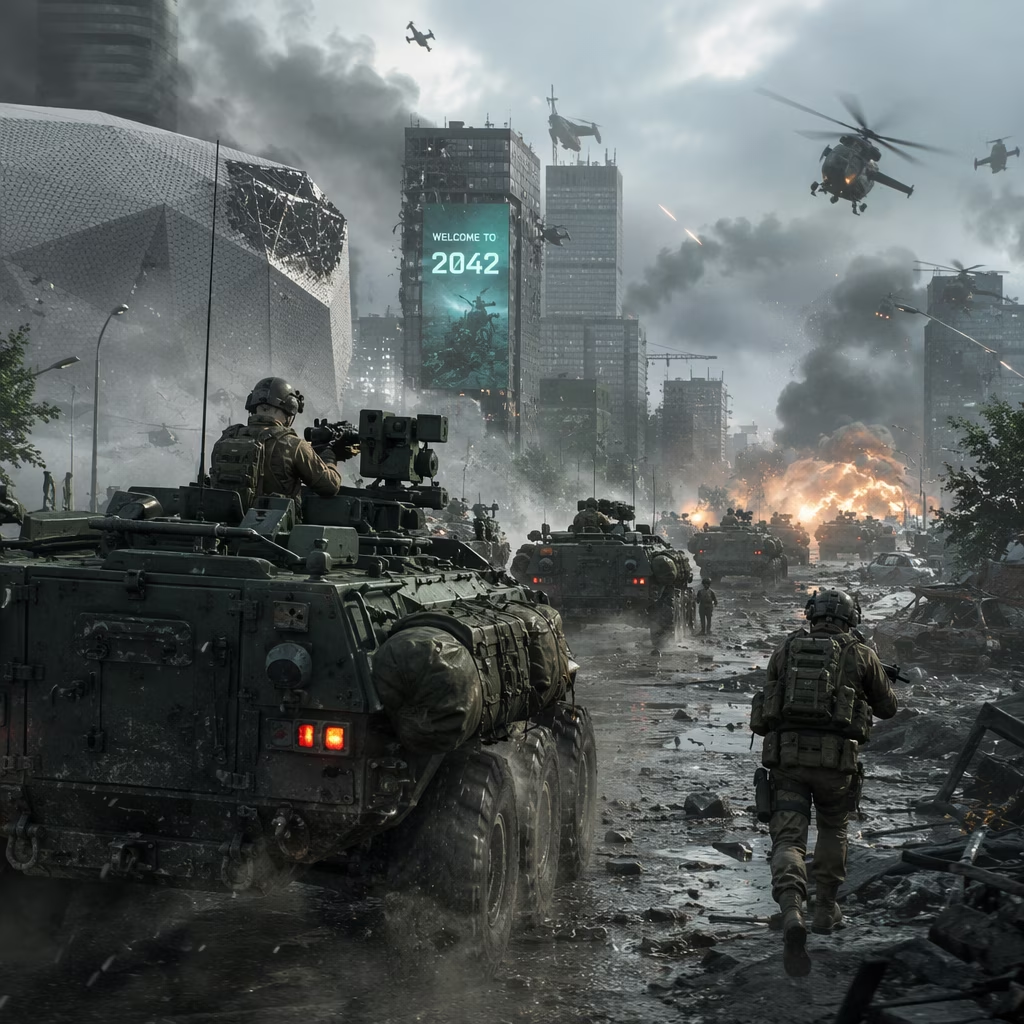
Rewind to February 2022. Battlefield 2042 was barely two months old and already in critical condition. The concurrent player count on Steam had embarrassingly dipped below that of its older sibling, Battlefield V. Let that sink in: a fresh, heavily marketed blockbuster couldn’t keep up with a game many had already written off. EA was disappointed, and the community was straight-up mutinous. The hotfix, pushed out across all platforms, didn’t promise new guns, rebalanced specialists, or that long-awaited scoreboard. Nope. The only headline was “more stability” and the reactivation of the Renewal map on Xbox One and PlayStation 4. It was like a mechanic telling you they’ve fixed your rattling engine, but really they just tightened a single bolt and hope you won’t notice the smoke.
You’d think a studio with DICE’s pedigree would be dropping game-changing updates left and right. But, man, they were in a totally different kind of battle.
Around that time, the roadmap started leaking like a rusty pipe. DICE confirmed that Season One wouldn’t land until summer 2022—a massive delay for a live-service title. The reason? Core mechanics needed a serious rethink. There was a laundry list of stuff to fix: the abysmal user interface, the controversial Specialist system, the catastrophic map design that made every firefight feel like a track meet in an empty parking lot. In March 2022, they were supposedly cooking up a proper scoreboard and voice communication (VOIP), features that somehow shipped missing. Imagine that: a team-based shooter where you couldn’t talk to your squad.
Meanwhile, EA was architecting a secret weapon. A new studio, spearheaded by Marcus Lehto—the co-creator of Halo—was tasked with building story-driven content for Battlefield 2042. It was a clear signal that even the publisher knew the endless sandbox chaos wasn’t cutting it. Players were craving a sense of purpose, some narrative tissue to connect the explosions. And then came the leaks about the first seasonal map, a slice of Canada that would arrive later. Rumors painted it as lush and detail-dense, a sharp contrast to the sterile, giant arenas that launched with the game. The existing maps were so devoid of life that gamers joked they were post-apocalyptic even before the match started.
DICE, for its part, did promise improvements to those launch maps, but when pressed for specifics, they went quiet. “We hear you,” they said, and then basically vanished into a bunker of code. It was frustrating, sure, but also a little bit tragic. You could almost feel the developers sweating through the screen, trying to stitch together a parachute after jumping from the plane.
In 2026, we know how the story continued. That tiny stability hotfix didn’t turn the tide. It was a Band-Aid on a wound that needed surgery. But it’s a moment worth remembering—a symbol of an era when one of gaming’s most beloved franchises nearly lost its way. The lessons were hard-won: you can’t ship a product half-baked and expect live service to magically fix it later. And sometimes, a hotfix that only adds “more stability” is actually the most honest admission that everything is unstable.
According to coverage from Rock Paper Shotgun, the most telling part of Battlefield 2042’s post-launch arc wasn’t any single balance tweak, but the way incremental patches tried to stabilize a foundation that players felt was missing key pillars—cohesive map flow, readable UI, and basic social tools that define squad shooters. Looking back, the “stability hotfix” era reads less like routine maintenance and more like a public checkpoint in a larger rebuild: when a live-service game ships without the connective tissue that makes matches feel purposeful, even technically successful updates can land as symbolic rather than transformative.