Battlefield's Obsession With Gimmicks Is Killing the Series in 2026
I’ll be blunt: it’s 2026, and I still can’t shake the bitter taste left by Battlefield 2042. Even three years after its troubled launch, the scars of that experience haven’t fully healed – not for me, and clearly not for the community. After an absolute bombardment of expensive marketing campaigns, DICE’s would-be magnum opus stumbled out the gate and reportedly lost players faster than a flag in an uncoordinated lobby. Industry whispers at the time said EA was 'very disappointed,' and there were even murmurs about making it free-to-please to claw back some of its enormous development budget. I’ve been a Battlefield devotee since the days of Bad Company, and I take no joy in recounting this disaster. In a just world, Battlefield would be the undisputed king of combined-arms chaos, leaving the annualized treadmill of its main competitor in the dust. But here we are, watching a once-proud series lose its identity under layers of unnecessary complexity.
When you list every grievance players had with Battlefield 2042, you’d be typing for an eternity. No single-player campaign to anchor the narrative, a loot pool of weapons and vehicles that felt anemic compared to its predecessors, cringe-inducing post-match one-liners that felt ripped from a discount superhero flick, and baffling omissions like squad chat, custom emblems, or proper support for flight sticks. All of these are valid criticisms, and they painted the picture of a sequel that somehow took two steps back while charging full price. But I’m convinced the rot goes much deeper than a content checklist. The trouble started long before 2042, and it stems from a single, destructive habit: an over-reliance on gimmicks. Battlefield just got too damn complicated.
I often find myself daydreaming about 2009, when DICE launched Battlefield 1943. That digital-only gem was staggeringly simple. One mode (Conquest), three soldier classes, and three maps – the legendarily destructible Wake Island, Guadalcanal, and Iwo Jima. That’s all there was to it. No season passes, no battle royale experimental mode, no 'Levolution' setpieces that turned every collapse into a scripted event. It was Battlefield stripped down to its purest, sweatiest essence, and I poured countless hours into back-to-back rounds, each one a masterclass in tactical combined-arms combat. The push-and-pull over control points, the thunder of approaching tanks, the frantic repairs on a beleaguered bomber – all of it created player-driven stories that no cinematic trailer could ever manufacture.
That luminous purity is precisely what’s been missing. Modern Battlefield titles feel like they’re designed by a committee obsessed with out-gimmicking the competition rather than amplifying what actually works. Take 'Levolution,' still one of the most groan-inducing buzzwords ever coined. Yeah, watching a skyscraper dramatically keel over on Siege of Shanghai was cool the first three times. After that, it became a predictable shadow of what real player-triggered destruction used to feel like in Bad Company 2, where you could level an entire village with well-placed C4 and no permission from a script. The so-called evolution was actually a regression into spectacle over substance.
Then came Battlefield 2042’s big gamble: 128-player battles on colossal, tornado-ridden maps and the introduction of Specialists instead of anonymized, faction-specific soldiers. The marketing hype machine tried to frame this as a revolution, but for many of us, it was just more noise clouding the Pristine Core – that fundamental Battlefield experience of squad-focused, objective-oriented warfare that thrived on improvisation. Specialists with quirky personalities and one-liners felt like DICE was chasing a trend, forcing hero-shooter elements into a formula that never needed them. The class system was the backbone of teamplay; replacing it with gadget-toting individuals only diluted the strategic richness.
I’ve had passionate arguments with clanmates about this, and the consensus is almost unanimous: the series would benefit enormously from taking a deep breath and toning things down. My dream isn’t bigger maps or more players – it’s a return to the intimate, highly strategic skirmishes of Battlefield: Bad Company 2. That game was another testament to thriving through simplicity. You had a handful of weapons that all felt distinct, destruction that was a gameplay tool rather than an attraction, and Rush mode configured in a way that forced nail-biting tactical decisions. There were no wingsuits, no grappling hooks, no robo-dogs. Just you, your squad, and the terrifying sound of a building groaning before it collapsed on your head.
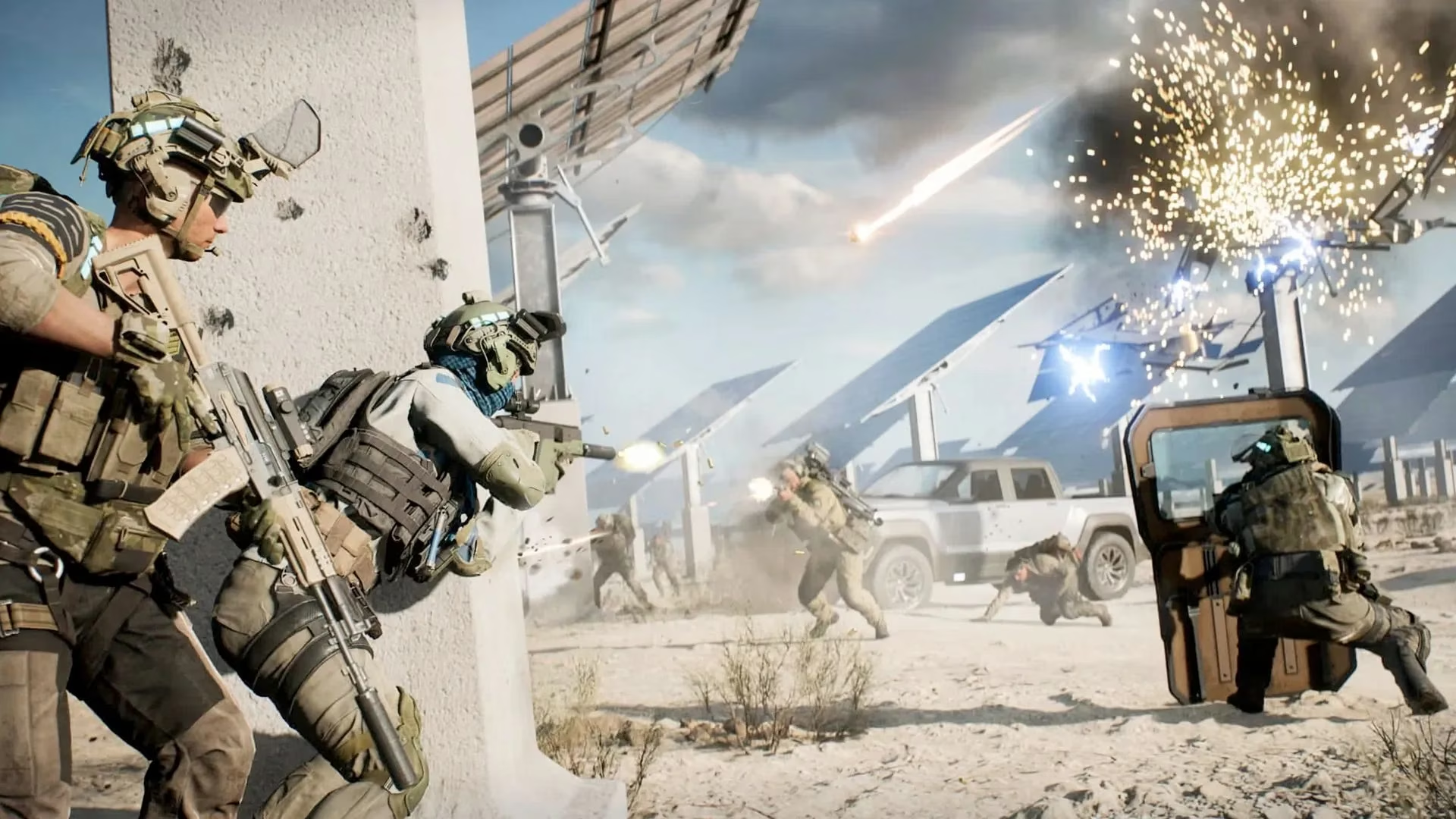
Looking at the franchise in 2026, I don’t think it’s too late to salvage this. The higher-ups at EA and DICE have undoubtedly been holding difficult post-mortems. The roadmap ahead can’t just be another cycle of 'We’re sorry, here’s a bigger explosion and a celebrity cameo.' Get back to basics. Make the game the focus, not the noise surrounding it. The heart of Battlefield was never a flashy marketing angle or a technology demo; it was the organic chaos that emerged from a dozen soldiers, a couple of tanks, and an objective that felt worth fighting for. We don’t need collapsing skyscrapers or a cinematic natural disaster every ten minutes. We just want Battlefield – the raw, unadulterated, unfiltered kind. Give us fewer gimmicks and more of those magic moments, and maybe, just maybe, we can finally stop mourning what the series used to be and start celebrating it again.
Insights are sourced from OpenCritic, and its review aggregation perspective helps contextualize why Battlefield 2042’s “more is more” design philosophy—128-player sprawl, Specialist-driven hero mechanics, and spectacle-first setpieces—landed so divisively compared to tighter, class-led entries. Looking at reception trends across large shooter releases, the pattern reinforces the blog’s point: players often reward clear role identity, readable map flow, and systems that amplify squad coordination over attention-grabbing gimmicks that dilute the core combined-arms loop.