Battlefield 2042's 'Return to Class' Update: A Well-Intentioned Yet Flawed Step Forward
Amidst the retextured cliffs and repositioned crates of the newly redesigned Breakaway map, a familiar feeling persists for players of Battlefield 2042 in 2026: a sense of being surrounded by enemies yet profoundly isolated. Snipers, perched on distant ice walls, continue to pick off targets from the main spawn point, while the chaotic flow of battle is constantly disrupted by enemy paratroopers and persistent UAVs. This paradox—a grand scale achieved at the cost of cohesive, team-driven gameplay—has haunted the title since its launch. The major 3.2 update, dubbed 'Return to Class,' represents developer EA DICE's latest attempt to remedy these foundational issues, seeking to reintroduce the squad-based synergy that once defined the franchise.
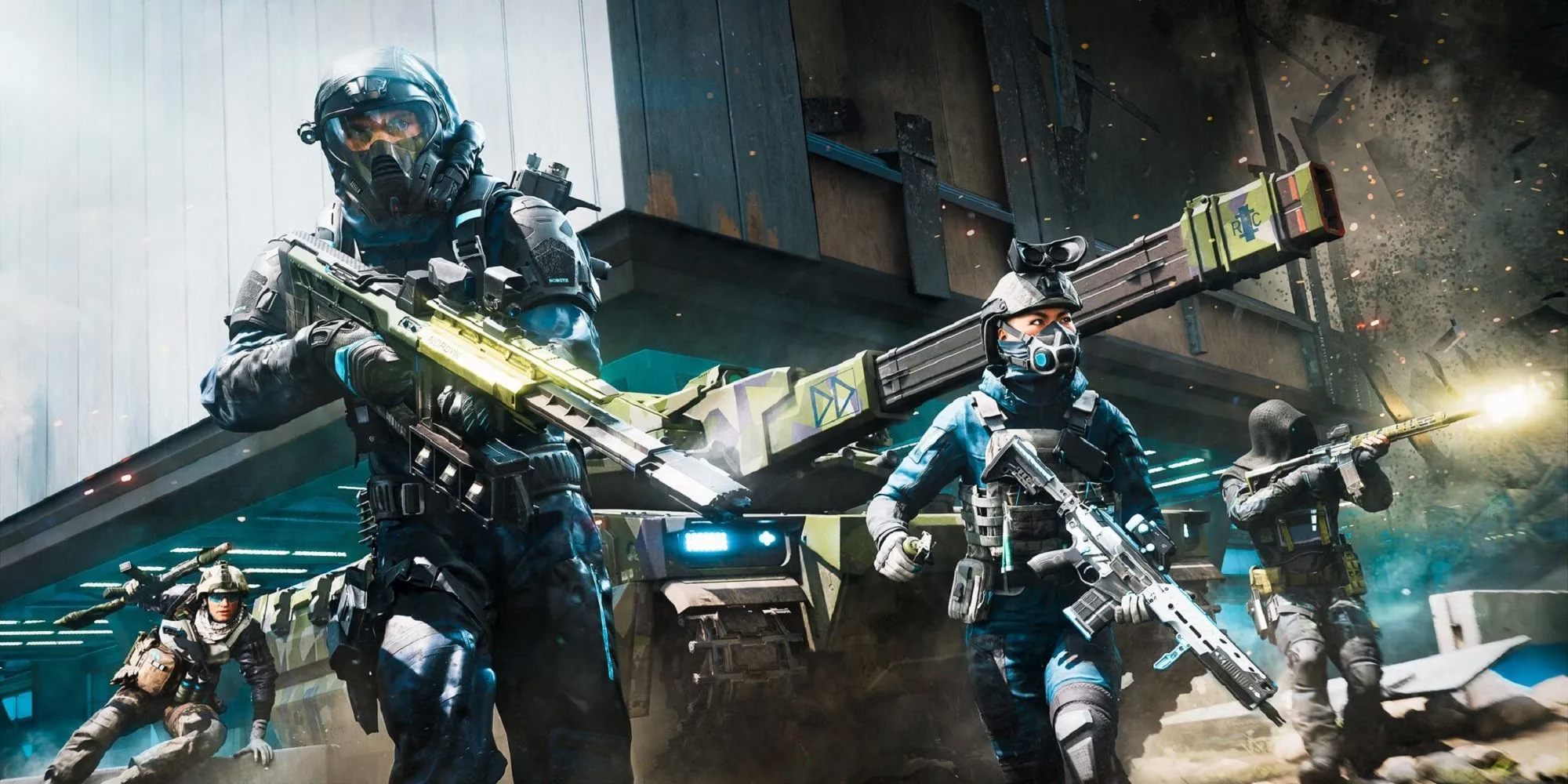
The core promise of the 'Return to Class' update is a structural shift back to a more traditional class system, a direct response to widespread criticism of the game's initial Specialist system. On paper, the concept is straightforward: assign the game's various Specialists to defined roles—Assault, Engineer, Support, and Recon—and restrict their equipment to foster team interdependence. The redesigned Breakaway map, historically one of the most sparsely populated and sniper-friendly locales, has been compacted. Key objectives, like the oil rig, have been moved closer together, theoretically encouraging more intense firefights and reducing the vast, empty spaces that plagued the original design.
However, the implementation of this class system reveals significant contradictions. While Specialists are now grouped under class banners, the system's impact is severely diluted. Crucially, all classes retain access to the full arsenal of primary weapons. This single decision strips away a fundamental pillar of class identity. In classic Battlefield titles, a player could assess their squad's composition at a glance—noting the absence of a Medic or an Anti-tank specialist—and choose a role to fill the gap. That tangible sense of contributing to the team's needs is now muted. The only meaningful distinction between classes lies in their gadget selections, but even this has led to puzzling imbalances.
🔍 A Closer Look at the Class Gadget Dilemma
The gadget allocations have created new meta problems. Most notably, the Support class has been designated as the sole carrier for both Ammo and Medical Crates. This centralizes two critical support functions into a single role, transforming the Support Specialist into an overloaded 'Santa’s sack' of team supplies. This design undermines the classic Battlefield tradition where multiple players could contribute modestly to the team's sustainment—a Medic dropping health packs, an Engineer supplying rockets. Now, the responsibility falls disproportionately on one class, ironically reducing the incentive for others to engage in supportive play.
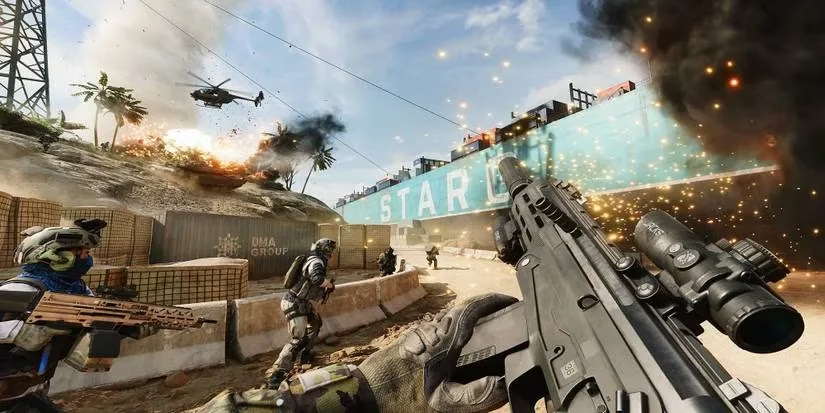
Furthermore, the update introduces Class-Specific Weapon Proficiencies, passive bonuses tailored to each role. For most classes, these are subtle. For the Recon class, however, the proficiency is a game-changer: instant and constant steady scope hold. This provides a massive buff to snipers, a group already considered overpowered, especially on maps like Breakaway. Despite the addition of new cover like sandbags and shipping containers, snipers still dominate from their elevated ice cliff vantage points, enjoying top-down views over large portions of the combat zone. The new proficiency only exacerbates this issue, making the Recon class more formidable and frustrating to play against.
🗺️ Map Redesign: From Bleak to Middling
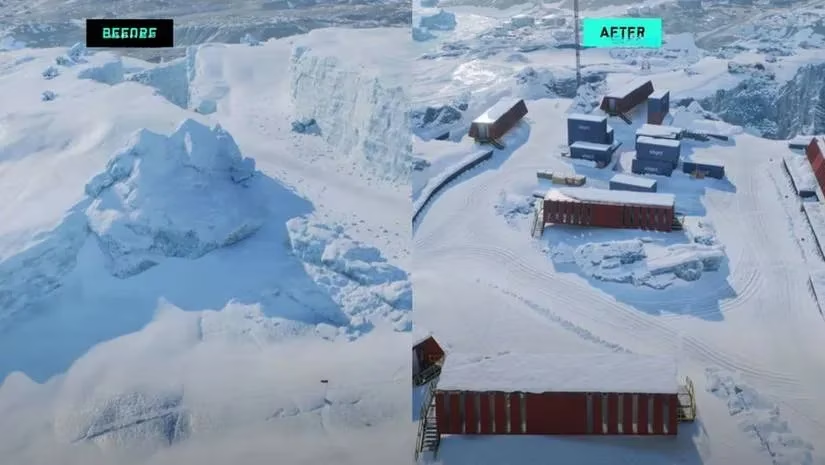
The visual and structural overhaul of the Breakaway map is arguably the update's most successful element. The environment feels more alive and less desolate. The condensed layout has indeed produced more frequent skirmishes, such as protracted firefights around the relocated oil rig. However, it's important to contextualize this improvement. Breakaway was frequently cited as one of the game's weakest maps. The redesign elevates it from 'objectively bad' to 'perfectly average,' but that is a low bar to clear. For many veterans, the effort might have been better spent introducing more beloved legacy maps into the Portal mode, which offers a more reliable nostalgic thrill.
The fundamental tension of Battlefield 2042 remains unresolved. The game was originally designed around high-mobility, lone-wolf Specialists capable of wingsuiting, grapple-hooking, and sprinting across the battlefield with autonomous flair. Trying to graft a traditional, teamwork-oriented class system onto this framework feels like a retroactive patch rather than an organic design. The returning class system often feels like an apology in the form of a feature—a recognition that the game strayed from its roots, but not a fully committed correction. Its presence is symbolic, acknowledging past missteps, but its impact on the moment-to-moment gameplay is frustratingly minimal.
| Aspect | Promise of 'Return to Class' | Current Reality in 2042 |
|---|---|---|
| Class Identity | Distinct roles with unique weapons and team functions. | Roles blurred; all classes use all weapons. Only gadgets differ. |
| Team Synergy | Squads work together, filling compositional gaps. | Support class overloaded; others have less incentive to support. |
| Map Flow | Redesigned maps foster closer combat and clear fronts. | Improved but snipers still dominate; 'fronts' remain chaotic. |
| Specialist vs. Class | Class system supersedes Specialist individuality. | Specialist abilities still define gameplay; class system is secondary. |
In conclusion, the 'Return to Class' update for Battlefield 2042 is a well-intentioned but fundamentally flawed step. It demonstrates that EA DICE is listening to community feedback and is aware of the series' core tenets. Yet, by trying to please both fans of the old system and the new Specialist paradigm, it satisfies neither completely. The update creates new imbalances while only partially solving old ones. As the studio looks ahead to the next chapter in the Battlefield saga, now in active development, this update serves as a hopeful signal—a glimmer that suggests a future 'return to roots' might be possible. For the present state of Battlefield 2042, however, the class system remains more of a nostalgic nod than the transformative fix the game desperately needs.