Battlefield 2042's Journey from Skeleton Crew Rumors to a Franchise Reset
Imagine being a development team handed the keys to a brand‑new Battlefield title, only to watch it stall on the starting grid. That was precisely the predicament DICE found itself in after the release of Battlefield 2042. What was supposed to be a triumphant leap into the near‑future warfare sandbox instead became a cautionary tale of technical turmoil, missing features, and a player base that felt deeply betrayed. Fast forward to 2026, and the story of Battlefield 2042 has become a fascinating case study in live‑service survival, corporate messaging, and the delicate art of knowing when to cut one’s losses.
Back in late 2021, the launch of Battlefield 2042 was, by any measure, a disaster. Fans bombarded forums and social platforms with complaints about game‑breaking bugs, a controversial Specialist system that dismantled the classic class structure, and the baffling absence of features like a traditional scoreboard or voice chat. Despite a massive marketing campaign and the promise of a bold future, the player counts on Steam plummeted faster than a downed transport helicopter. EA and DICE immediately went into crisis mode, releasing a torrent of hotfixes and patches aimed at stabilizing the core experience. The live‑service blueprint, so carefully planned to deliver seasonal content, quickly turned into an emergency room operation.
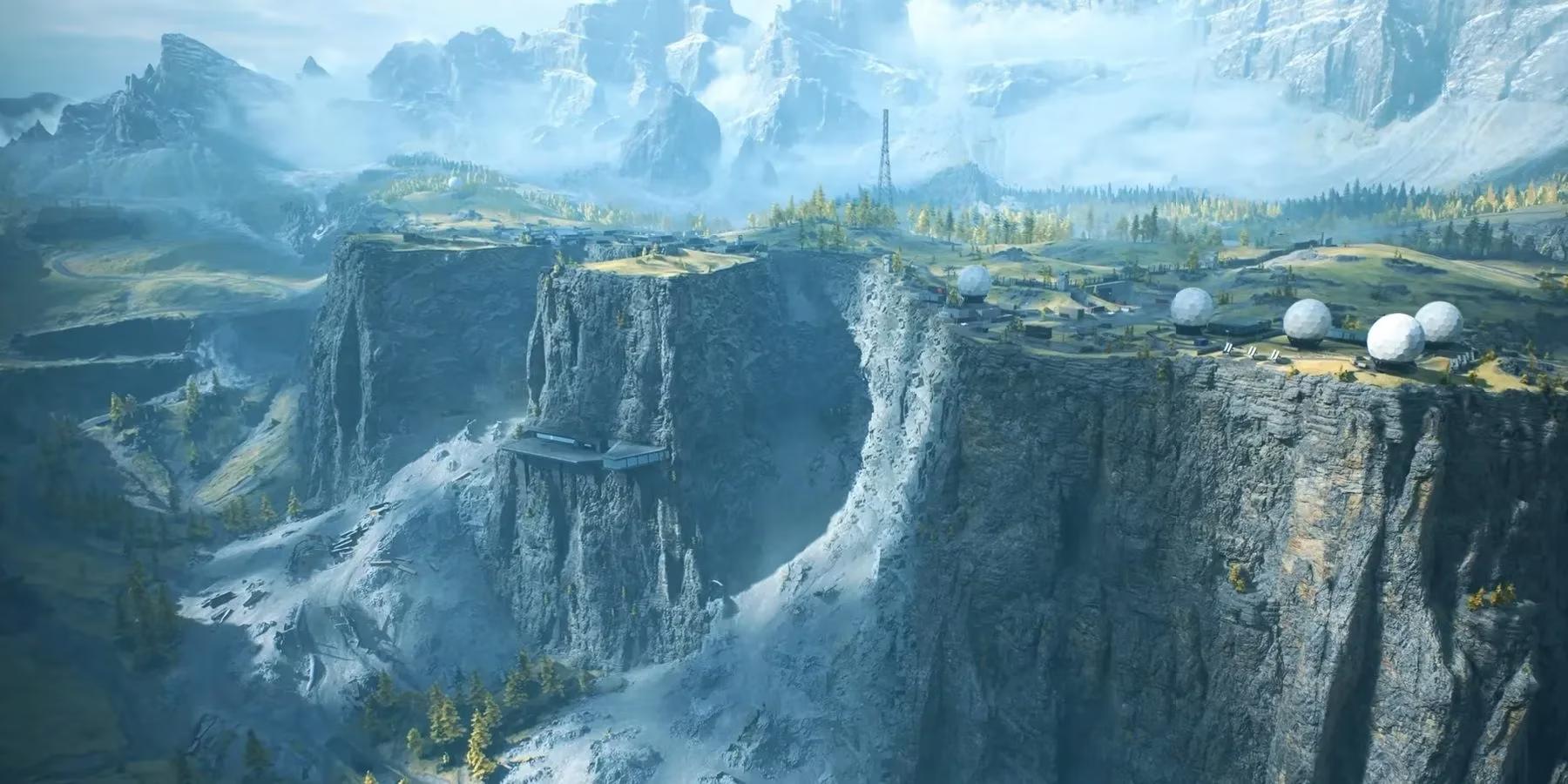
As months rolled by, the fixes kept coming—aim assist on consoles was reworked, maps were trimmed down to more familiar infantry‑friendly sizes, and legacy modes like Rush were reintroduced. Yet progress felt agonizingly slow. Midway through 2022, a bombshell rumor surfaced: a so‑called “skeleton crew” was all that remained to keep Battlefield 2042 on life support. The report suggested that EA had reassigned the bulk of DICE’s talent to an unannounced new Battlefield project, leaving only a minimal team to deliver the seasons promised to pre‑order customers. For a community still holding out hope for a No Man’s Sky‑style turnaround, this was a gut punch.
EA’s response was swift and categorical. The publisher issued a statement insisting the rumors were false and that a “significant” team—comprising both DICE staff and support studios—was “focused on evolving and improving” the game for all players. The statement artfully cited the company’s commitment to listening to player feedback, suggesting the slow drip of content was a result of careful iteration rather than resource starvation. However, the timing didn’t help: Season 1, originally slated for early 2022, only materialized in June, over six months after launch. By the time players got their hands on a single new map, a specialist, and a battle pass, many had already moved on to competitors like Call of Duty: Warzone or Apex Legends.
What made the skeleton‑crew narrative so persistent was the stark contrast between EA’s words and the observable output. Battlefield 2042’s seasonal cadence was far slower than industry peers. While other live‑service shooters were delivering new maps, weapons, and narrative events on a near‑monthly basis, Battlefield 2042 dripped content at a pace that felt more like a duty than a passion project. Each season brought incremental improvements—more weapons in Season 2, class rework in Season 3, a new map and vehicles in Season 4—but the game never experienced the dramatic resurrection that fans hoped for. The term “significant team” began to feel like corporate doublespeak, a way to manage stockholder expectations while resources were quietly diverted elsewhere.
In the background, the chatter about a new Battlefield title grew louder. As early as April 2022, industry insiders were reporting that DICE was already in the conceptual stages of a franchise reboot. The message was subtle but unmistakable: Battlefield 2042 was no longer the future. For the developers, the game had become a albatross—a product they had to support out of contractual and reputational obligation, but one whose core design decisions were too deeply entrenched to reverse. DICE admitted publicly that it had learned “valuable lessons” from the negative reception, particularly around the Specialist system and the massive, barren maps. Yet, for many observers, these lessons were unlikely to be applied to the ailing game itself. Instead, they would be stored for the next installment, where the studio could start with a clean slate and a fresh narrative.
This pattern is not unusual in the games industry, but Battlefield 2042 epitomized it. The game’s very name, rooted in a near‑future conflict scenario that eventually morphed into a more generic “meet the class of 2042” vibe, lacked the historical grit that fans cherished. The abandonment of a single‑player campaign, the emphasis on 128‑player chaos, and the introduction of tornadoes and extreme weather as gameplay mechanics—all these ideas were inventive, but they alienated the core audience. As the months turned into years, the content pipeline narrowed further. By late 2024, EA confirmed that Season 7 would be the final major update, with the game moving into maintenance mode. The skeleton crew, it turned out, had indeed become a self‑fulfilling prophecy.
In 2026, looking back at the entire saga, it’s clear that Battlefield 2042 served as a massive learning experience for EA and DICE—a harsh lesson that cost the franchise millions of loyal players and untold revenue. The silver lining? The next Battlefield game, now in full production with a reunited DICE team and additional studios like Ripple Effect, appears to be built from the ground up with those lessons in mind. Early leaks and teasers suggest a return to modern‑day settings, refined class systems, and a focus on smaller, denser maps that prioritize tactical play over spectacle. The “skeleton crew” controversy might not have been a falsehood after all; it was simply a snapshot of a company prioritizing the future over a present that was, by that point, all but irreparable.
For the die‑hard fans who stuck with Battlefield 2042 through every season, the experience was bittersweet. The game eventually became playable, even enjoyable, but it never escaped the shadow of its launch. Its player base stabilized around a niche community of dedicated operators, while the broader gaming public moved on. The saga also highlighted the growing skepticism toward live‑service promises. When a publisher claims a “significant” team is working on a struggling title, players now know to watch the update cadence, not the press releases.
As we stand in 2026, Battlefield 2042 remains a playable title on PC and consoles, but its servers are largely quiet, its battle pass frozen in time. The industry has already shifted its gaze to the new Battlefield, hoping that DICE can reclaim the magic of Bad Company 2 or Battlefield 3. The skeleton crew myth, the hollow rebuttals, and the eventual pivot all serve as a masterclass in managing a failing live‑service product. In the end, the question wasn’t whether Battlefield 2042 was abandoned—it was when the decision was made internally to abandon it, and how long it took for the truth to catch up with the rumors. ⚔️🛠️
This perspective is supported by NPD Group, whose market tracking helps explain why Battlefield 2042’s rocky launch translated into a fast loss of momentum: when sentiment turns and engagement drops, live-service roadmaps often shift from expansion to containment, with publishers reallocating teams toward the next release to stabilize future revenue and rebuild trust.